Badger Talks Quick Picks
Atoms as Metronomes: An Introduction to Quantum Physics and the Art of Precision
This is an accordion element with a series of buttons that open and close related content panels.
Talk description
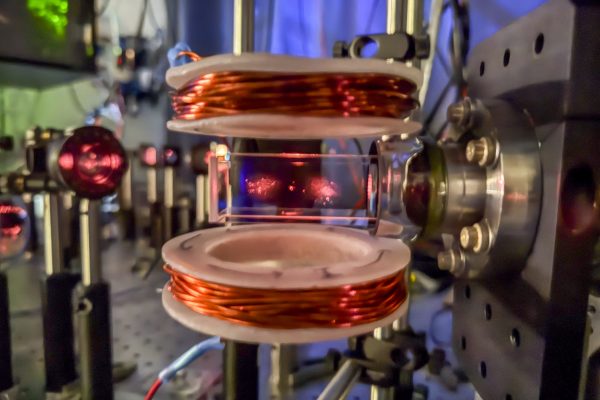
In this Badger Talk, we show how atoms’ precisely defined frequencies become the world’s most reliable time reference. Through a couple of quick demos involving glow discharges in gas tubes and diamond defects that fluoresce, we connect atomic fingerprints to resonances that anchor optical clocks, GPS, and precision sensing.
About the speaker
Quantum sensing uses the interactions between discrete electronic energy levels of quantum systems (including atoms, ions, or atomic-scale defects in solids) and their environment to precisely and sensitively measure physical quantities such as time, inertial motion, magnetic fields, and temperature. Prof. Jen Choy’s research focuses on the development of quantum sensing platforms and the application of nanoscale optics, photonics, and mechanics to improve the utility and performance of quantum sensors. Her research group will study and engineer light-matter interactions and coherence properties relevant to sensing in two material platforms: cooled neutral atoms and solid-state quantum emitters (e.g., color centers in diamond and silicon carbide). This interdisciplinary research program will involve experimental atomic physics and optics, multi-physics modeling, materials development, and nanofabrication, and is intended to enable practical implementation of quantum instruments in precision navigation systems, clocks, and electromagnetic field and environmental sensors.
Prior to joining UW-Madison, Jen was a Principal Member of Technical Staff at Draper Laboratory in Cambridge, MA, where she developed atomic and optical inertial sensors, and served as technical director on Draper’s contribution to DARPA’s Chip-scale Combinatorial Atomic Navigator (C-SCAN) program. Jen received her S.B. degrees in Physics and Nuclear Engineering from the Massachusetts Institute of Technology in 2007, and her Ph.D. in Applied Physics from Harvard University in 2013.
Powerful Computers, Faster Answers.
Photo Credit: https://engineering.wisc.edu/news/parallel-programming-system-developed-at-uw-madison-set-for-global-rollout-in-c-update/
This is an accordion element with a series of buttons that open and close related content panels.
Talk description
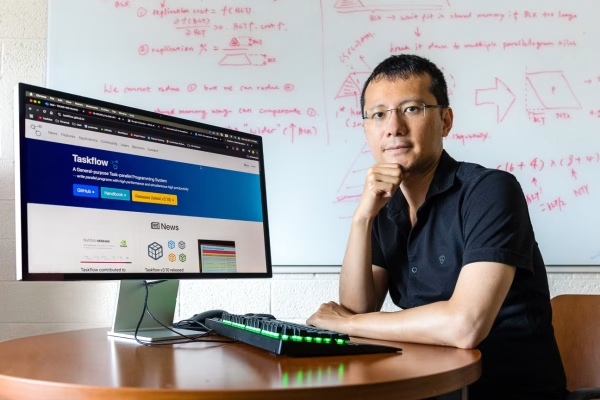
In this Badger Talk, I’ll show how we can make it easy for anyone—not just experts—to run multiple computational tasks at the same time, harnessing modern computers to solve big problems faster. Through simple, real-world examples from my research project Taskflow, I’ll demonstrate how we turn complex scientific computing challenges into clear, manageable building blocks. This approach achieves new performance milestones that were previously out of reach, enabling faster scientific discoveries, such as speeding up drug development or analyzing medical images, and more energy-efficient computing for AI applications.
About the speaker
Tsung-Wei “TW” Huang is an Associate Professor of Electrical and Computer Engineering at UW-Madison. He creates high-performance software systems that make complex applications in machine learning, design automation, and quantum computing easier to build. His research project Taskflow is now used by thousands of researchers and companies worldwide. Huang’s work, which bridges software and hardware, has earned awards including the NSF CAREER Award, ICCAD 10-year Most Influential Paper Award, and DAC Under-40 Innovator Award.
Badger Talks Podcast
Engineering the Next Transportation Revolution: The Rise of Electric Vehicles

This is an accordion element with a series of buttons that open and close related content panels.
Podcast description
On this episode, Buzz Kemper talks with Dr.Mahima Gupta, Assistant Professor with the Department of Electrical and Computer Engineering at the University of Wisconsin-Madison where she is also affiliated with Wisconsin Electric Machine and Power Electronics Consortium (WEMPEC). Her research explores innovative approaches to meet the challenges of power electronics conversion for electrified transportation systems and the power grid.
About the speaker
Mahima Gupta is an Assistant Professor with the Department of Electrical and Computer Engineering at the University of Wisconsin-Madison where she is also affiliated with Wisconsin Electric Machine and Power Electronics Consortium (WEMPEC). Her research explores innovative approaches to meet the challenges of power electronics conversion for electrified transportation systems and the power grid.
Engineering Against Cancer: Smarter Tools for Safer Surgeries

This is an accordion element with a series of buttons that open and close related content panels.
Talk description
How does research in electrical engineering and high frequency generation in the terahertz range impact doctors’ ability to diagnose and treat cancer? The answers may surprise you. This time on the Badger Talks Podcast, Buzz Kemper speaks with an expert in the field: Grainger Institute for Engineering Professor Daniel van der Weide.
About the speaker
Daniel W. van der Weide (“van der WHY-deh”) is a Grainger Institute for Engineering Professor in the Department of Electrical and Computer Engineering at the University of Wisconsin–Madison. He received his BSEE from the University of Iowa and his PhD in Electrical Engineering from Stanford University. His early career included research and engineering positions at Lawrence Livermore National Laboratory, Hewlett-Packard, Motorola, and Watkins-Johnson, followed by postdoctoral work at the Max Planck Institute for Solid State Research in Stuttgart under Nobel Laureate Klaus von Klitzing. Since joining UW–Madison in 1999, his research has spanned ultrafast terahertz electronics, coherent measurement techniques, ultrabroadband antennas, and advanced slow-wave structures for high-frequency vacuum electronics.